Grid List Quotes Pictures Events
Loading Full Historical Timeline
Loading Full Historical Timeline
on 1/15/1788
"The known propensity of a democracy is to licentiousness which the ambitious call, and ignorant believe to be liberty. "
on 1/25/1788
"To preserve liberty, it is essential that the whole body of the people always possess arms and be taught alike, especially when young, how to use them."
on 2/20/1788
"Who are the militia? Are they not ourselves? It is feared, then, that we shall turn our arms each man against his own bosom. Congress have no power to disarm the militia. Their swords, and every other terrible implement of the soldier, are the birthright of an American . . . . [T]he unlimited power of the sword is not in the hands of either the federal or state governments, but, where I trust in God it will ever remain, in the hands of the people."
on 6/5/1788
"Is the relinquishment of the trial by jury and the liberty of the press necessary for your liberty? Will the abandonment of your most sacred rights tend to the security of your liberty? Liberty, the greatest of all earlthy blessings - give us that precious jewel, and you may take every things else! . . . Guard with jealous attention the public liberty. Suspect every one who approaches that jewel."
on 6/10/1788
"How prone all human institutions have been to decay; how subject the best-formed and most wisely organized governments have been to lose their check and totally dissolve; how difficult it has been for mankind, in all ages and countries, to preserve their dearest rights and best privileges, impelled as it were by an irresistible fate of despotism."
on 6/14/1788
"Those gentlemen, who will be elected senators, will fix themselves in the federal town, and become citizens of that town more than of your state."
on 6/17/1788
"Nothing so strongly impels a man to regard the interest of his constituents, as the certainty of returning to the general mass of the people, from whence he was taken, where he must participate in their burdens."
in 1788
"We may with reverence say, that our Creator designed men for society, because otherwise they cannot be happy. They cannot be happy without freedom; nor free without security; that is, without the absence of fear; nor thus secure, without society. The conclusion is strictly syllogistic?that man cannot be free without society. Of course, they cannot be equally free without society, which freedom produces the greatest happiness."
in 1788
"As in forming a political society, each individual contributes some of his rights, in order that he may, from a common stock of rights, derive greater benefits, than he could from merely his own; so, in forming a confederation, each political society should contribute such a share of their rights, as will, from a common stock of these rights, produce the largest quantity of benefits for them."


in 1788
"While the business of education in Europe consists in lectures upon the ruins of Palmyra and the antiquities of Herculaneum, or in disputes about Hebrew points, Greek particles, or the accent and quantity of the Roman language, the youth of America will be employed in acquiring those branches of knowledge which increase the conveniences of life, lessen human misery, improve our country, promote population, exalt the human understanding, and establish domestic social and political happiness."
in 1788
"I ask, Sir, what is the militia? It is the whole people. To disarm the people is the best and most effectual way to enslave them."
in 1788
"I ask, Sir, what is the militia? It is the whole people. To disarm the people is the best and most effectual way to enslave them."
in 1788
"We may with reverence say, that our Creator designed men for society, because otherwise they cannot be happy. They cannot be happy without freedom; nor free without security; that is, without the absence of fear; nor thus secure, without society. The conclusion is strictly syllogistic?that man cannot be free without society. Of course, they cannot be equally free without society, which freedom produces the greatest happiness."
in 1788
"As in forming a political society, each individual contributes some of his rights, in order that he may, from a common stock of rights, derive greater benefits, than he could from merely his own; so, in forming a confederation, each political society should contribute such a share of their rights, as will, from a common stock of these rights, produce the largest quantity of benefits for them."
in 1788
"The power of the people pervading the proposed system, together with the strong confederation of the states, will form an adequate security against every danger that has been apprehended."
in 1788
"What concerns all, should be considered by all; and individuals may injure a whole society, by not declaring their sentiments. It is therefore not only their right, but their duty, to declare them."
in 1788
"The minds of youth are perpetually led to the history of Greece and Rime or to Great Britain; Boys are constantly repeating the declamations of Demosthenes and Cicero, or debates upon some political question in the British Parliament."
in 1788
"The virtues of men are of more consequence to society than their abilities; and for this reason, the heart should be cultivated with more assiduity than the head."
in 1788
"Every child in America should be acquainted with his own country. He should read books that furnish him with ideas that will be useful to him in life and practice. As soon as he opens his lips, he should rehearse the history of his own country; he should lisp the praise of liberty, and of those illustrious heroes and statesmen, who have wrought a revolution in her favor."
in 1788
"It is an object of vast magnitude that systems of education should be adopted and pursued which may not only diffuse a knowledge of the sciences but may implant in the minds of the American youth the principles of virtue and of liberty and inspire them with just and liberal ideas of government and with an inviolable attachment to their own country."
in 1788
"Every small district should be furnished with a school, at least four months in a year, when boys are not otherwise employed. This school should be kept by the most reputable and well informed man in the district. Here children should be taught the usual branches of learning; submission to superiors and to laws; the moral or social duties; the history and transactions of their own country; the principles of liberty and government. Here the rough manners of the wilderness should be softened, and "
on 3/1788
"[W]here there is no law, there is no liberty; and nothing deserves the name of law but that which is certain and universal in its operation upon all the members of the community."
on 7/1788
"The true liberty of the press is amply secured by permitting every man to publish his opinion; but it is due to the peace and dignity of society, to inquire into the motives of such publications, and to distinguish between those which are meant for use and reformation, and with an eye solely to the public good, and those which are intended merely to delude and defame. To the latter description, it is impossible that any good government should afford protection and impunity."
in 1788
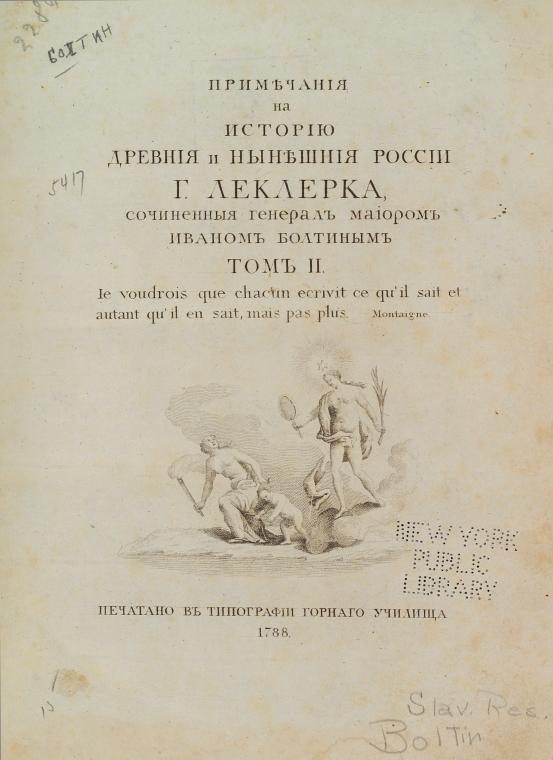
Prim?i?echan??i?a na Istor??i?u drevn??i?a i nyn?i?eshn??i?a Ross?i g. Leklerka vol. 2 title page